| Product Architecture |
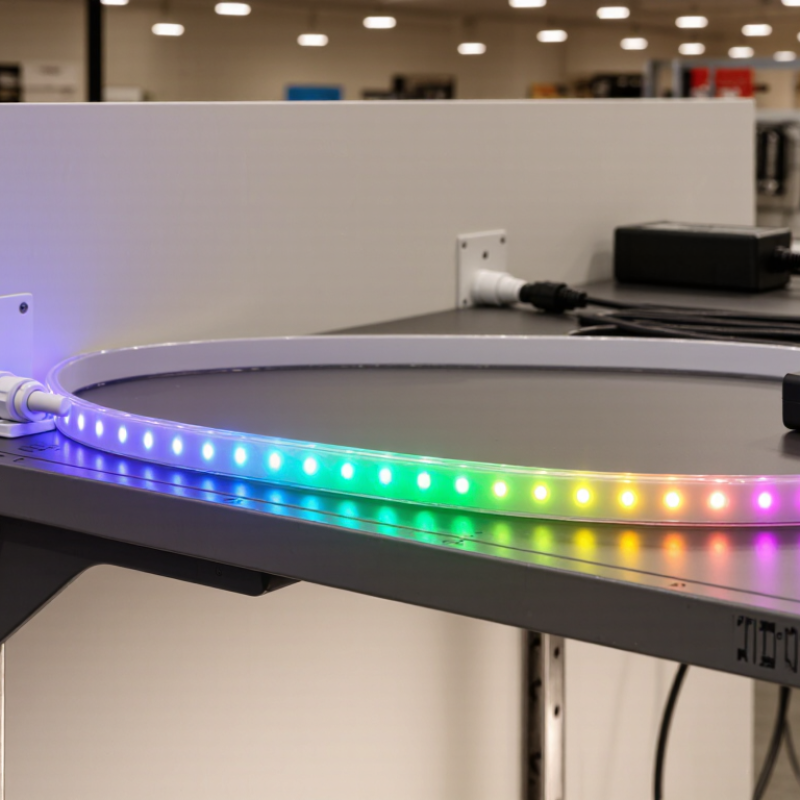
Flexible LED lightstrip supplied with controller, power adapter, connectors, and installation accessories. |
Modular design with replaceable controller and clearly labeled connection points. |
Product drawings, bill of materials, assembly samples, and compatibility test records. |
No exposed live parts; connectors must fit securely without excessive insertion force. |
| Input Voltage |
Low-voltage operation for consumer and commercial indoor applications. |
12 V or 24 V DC lightstrip; 24 V is generally preferred for longer runs because it reduces voltage drop. |
Rated-label photographs, electrical schematic, power-adapter specification, and load test. |
Actual operating voltage must match the controller and power adapter rating. |
| LED Density |
Even illumination with limited visible dark spots between LEDs. |
At least 60 LEDs per metre for general ambient lighting; 120 LEDs per metre for smoother decorative output. |
LED count per metre, illuminated sample inspection, and uniformity photographs. |
Uniform light appearance with no dead LEDs, severe color gaps, or visible solder defects. |
| Color Options |
Support for common residential, hospitality, retail, and entertainment applications. |
RGB or RGBIC for color effects; optional tunable white with a stated color-temperature range such as 2700–6500 K. |
Controller function list, app screenshots, color-temperature measurement, and sample demonstration. |
All advertised colors and scenes must operate consistently through the supplied controller. |
| Color Quality |
Stable color output across production batches. |
For white-light versions, target CRI ≥ 80 for general use and CRI ≥ 90 for premium retail or hospitality use. |
Independent integrating-sphere report or calibrated colorimeter results. |
Measured CRI and chromaticity must remain within the agreed product specification. |
| Luminous Performance |
Brightness must be suitable for the intended installation and not rely only on marketing claims. |
Declare lumens per metre, wattage per metre, and test conditions; avoid comparing figures measured under different conditions. |
Photometric report identifying LED density, input voltage, temperature, and test equipment. |
Sample output should meet the declared tolerance, commonly within ±10% unless otherwise agreed. |
| Power Consumption |
Transparent energy data for shipping, installation, and operating-cost calculations. |
Clearly state watts per metre, total reel wattage, standby consumption, and controller consumption. |
Power analyzer readings at minimum, typical, and maximum brightness. |
Measured full-load power must not exceed the declared rating by more than the agreed tolerance. |
| Thermal Management |
Reliable operation without excessive heat accumulation. |
Installation guidance should require an aluminum profile or suitable heat-dissipating surface for high-brightness or enclosed installations. |
Temperature-rise test, installation instructions, and thermal photographs. |
No discoloration, adhesive failure, controller shutdown, or unsafe surface temperature during the agreed test. |
| Cutting and Connection |
Easy customization for different installation lengths. |
Clearly marked cut points, reinforced solder pads, compatible extension cables, and polarity markings. |
Cutting diagram, connector samples, pull-force test, and installation trial. |
Cut sections must remain electrically safe and connectors must maintain stable contact after repeated installation. |
| Ingress Protection |
Protection level must match the target installation environment. |
IP20 for dry indoor areas; IP65 for splash-resistant applications; higher ratings only when the complete assembly is tested. |
Ingress-protection test report based on IEC 60529, where applicable. |
IP rating must appear on the product documentation and must not exceed the tested assembly configuration. |
| Adhesive and Mechanical Reliability |
Lightstrip must remain attached during normal installation and operation. |
High-quality backing adhesive, clean release liner, optional mounting clips, and installation-surface limitations. |
Peel-strength or holding-time test on representative surfaces and storage-condition records. |
No lifting, bubbling, cracking, or adhesive transfer after the agreed heat and duration test. |
| Smart Connectivity |
Stable pairing and predictable operation for the intended sales channel. |
Declare whether control uses Bluetooth, Wi-Fi, or another wireless method; identify supported operating systems and network requirements. |
Pairing test, connection-range test, app version record, user guide, and reset procedure. |
Pairing should be repeatable, reset should be documented, and essential functions should remain available after reconnection. |
| Software and Privacy |
Smart functions should be supported by maintainable software and clear user documentation. |
Document account requirements, permissions, firmware-update process, data handling, and end-of-support policy. |
Privacy notice, app release record, firmware-change log, and cybersecurity review appropriate to the sales market. |
No undisclosed mandatory subscription for advertised core functions; privacy information must be accessible to buyers. |
| Electrical Safety |
Protection against electric shock, overheating, short circuit, and incorrect connection. |
Use a suitable certified power adapter with over-current, over-voltage, and short-circuit protection where applicable. |
Safety test report, adapter documentation, dielectric-strength test, insulation test, and abnormal-operation test. |
Product markings, ratings, wire sizes, strain relief, and protective functions must match the technical file. |
| Applicable Standards |
Certification strategy must be selected according to the destination market and complete product configuration. |
Consider applicable requirements such as IEC 60598-1, IEC 62031, IEC 62471, IEC 60529, EMC standards, and regional requirements. |
Current laboratory reports, declarations of conformity, technical construction file, and critical-component list. |
Reports must identify the correct model, controller, adapter, input rating, and revision level. |
| EMC Performance |
Minimize radio interference and ensure stable operation near common household electronics. |
Evaluate conducted and radiated emissions, immunity, and harmonic-current requirements according to the destination market. |
EMC laboratory report covering the lightstrip, controller, and power adapter as sold. |
No abnormal flicker, unexpected reset, or communication loss during agreed immunity tests. |
| Material Compliance |
Materials should meet chemical restrictions required by the sales region. |
Provide documentation for applicable RoHS and REACH-related substance requirements; include battery compliance if a battery is supplied. |
Material declarations, supplier statements, and test reports for restricted substances when required. |
Documentation must cover cables, PVC or silicone materials, solder, plastics, controller housing, and packaging. |
| Production Quality Control |
Consistent output across large wholesale batches. |
Use incoming-material inspection, first-article approval, in-process checks, final inspection, and lot traceability. |
Quality-control plan, inspection checklist, defect classification, batch code, and corrective-action records. |
Agree on AQL levels, critical defects, major defects, minor defects, and sampling method before mass production. |
| Aging and Reliability |
Reduce early failures caused by LEDs, solder joints, controllers, and power supplies. |
Conduct powered aging at representative load and ambient conditions; publish a rated life only with defined test assumptions. |
Aging report, failure-rate record, temperature condition, operating cycle, and sample quantity. |
All units should pass functional inspection after aging, with failures recorded and analyzed. |
| Reel and Inner Packaging |
Prevent kinks, LED damage, connector damage, and moisture exposure during storage. |
Use a rigid reel or spool, protective film or bag, desiccant when appropriate, connector protection, and clear length labeling. |
Packaging specification, compression check, humidity-storage test, and pre-shipment photographs. |
Reels must arrive without deformation, loose components, damaged solder pads, or unreadable labels. |
| Retail Packaging |
Packaging should support shelf display, e-commerce fulfillment, and customer installation. |
Include product name, length, voltage, wattage, IP rating, contents, compatibility, safety warnings, QR or printed instructions, and barcode area. |
Approved artwork, packaging dieline, barcode verification, translation review, and packed-sample inspection. |
All claims on the package must match the tested product configuration and included accessories. |
| Carton and Palletization |
Protect goods during domestic and international transport. |
Use a strong corrugated carton, internal partitions where needed, moisture protection, carton markings, and stable pallet stacking. |
Carton specification, packed-carton weight, dimensions, stacking test, and transport simulation such as an applicable ISTA procedure. |
No crushed cartons, exposed products, shifted loads, or barcode damage after the agreed transport test. |
| Documentation Package |
Enable customs clearance, retail listing, installation, and after-sales support. |
Provide specification sheet, user manual, wiring diagram, safety instructions, test reports, declaration documents, and spare-part list. |
Controlled document set with revision numbers and destination-market language review. |
Documents must be complete, internally consistent, and supplied before final shipment approval. |
| Warranty and After-Sales |
Control replacement cost and protect wholesale customer satisfaction. |
Define warranty period, covered failures, response time, replacement process, spare controller availability, and failure-evidence requirements. |
Written warranty terms, service-level agreement, spare-parts plan, and historical failure analysis where available. |
Terms must identify exclusions clearly and provide a practical process for batch-related quality claims. |