Top Smart LED Manufacturers for Global Buyers

Choosing among the top Smart Led manufacturers requires more than comparing brightness, prices, or attractive product photographs. Global buyers need dependable evidence about engineering quality, factory capacity, certifications, and long-term support. This guide introduces manufacturers that deserve closer evaluation, while recognizing that market claims can change quickly.

A reliable supplier should explain LED chip selection, driver performance, thermal management, and expected operating life. Ask for testing records, sample units, warranty terms, and clear production timelines. A showroom may display perfect panels, yet real performance appears in warehouses, offices, streets, and homes after months of use. Small details matter, including connector quality, heat dissipation, packaging strength, and software updates.

No ranking is flawless. Buyer priorities differ.

Some manufacturers excel at custom design, while others offer stronger volume production or regional service networks. Communication also reveals practical experience. Can the supplier answer technical questions clearly? Does it identify limitations instead of promising everything? These responses can indicate professional honesty and operational maturity.

This overview considers manufacturers through an evidence-based lens. It examines product innovation, manufacturing consistency, energy efficiency, smart-control compatibility, customization, and customer support. It also considers regional requirements, because installation conditions in a humid coastal city differ from those in a dry industrial area. Certifications should be verified through current documents, not assumed from website badges. Independent testing remains valuable, although it may not capture every real-world challenge.

The goal is not to promote a single universal winner. It is to help buyers develop a practical shortlist, test products carefully, and select a Smart Led partner suited to their application, budget, and future plans.
Top Smart LED Manufacturers for Global Buyers

Smart LED Manufacturing: Definition, Technology, and Market Scope

Smart LED manufacturing combines semiconductor packaging, optical engineering, power electronics, wireless communication, and software control. It produces lighting that can adjust brightness, color temperature, schedules, and sensor responses. A connected lamp is not automatically a smart system. Reliable products need efficient drivers, thermal management, secure firmware, and stable communication inside a real building.

The U.S. Department of Energy reports that LED products use at least 75% less energy and last up to 25 times longer than incandescent lighting. These gains depend on installation quality and operating conditions. Poor heat dissipation can reduce service life. Manufacturing therefore involves more than assembling chips and housings. Engineers must test lumen output, color consistency, flicker, standby power, wireless range, and performance after repeated temperature changes.

Market scope is expanding across homes, offices, factories, streets, hotels, and agricultural facilities. MarketsandMarkets projected the global smart lighting market to grow from about USD 13.4 billion in 2024 to USD 27.7 billion by 2029. The figure suggests strong demand, but forecasts vary by definition and region. Some reports count connected bulbs only; others include controls, sensors, software, and installation. That difference matters. Buyers should request test records, energy data, interoperability details, and warranty conditions before comparing manufacturers. “Smart” remains an incomplete claim without measurable performance.

Smart LED Manufacturing: Technology Benchmarks and Market Scope

Luminous efficacy shows how efficiently a lighting technology converts electrical power into visible light. LED products generally provide higher efficacy than legacy lighting technologies, supporting smart lighting applications in residential, commercial, industrial, and outdoor markets.

Indicative industry ranges in lumens per watt (lm/W). Actual performance varies by product design, color temperature, driver efficiency, thermal management, and operating conditions.

Key Criteria for Evaluating Global Smart LED Manufacturers

Top Smart LED Manufacturers for Global Buyers

Choosing a smart LED manufacturer requires more than comparing catalog prices. Reliable evaluation begins with product performance, factory experience, and documented quality controls. Ask for test reports covering brightness, color accuracy, heat management, and wireless stability. A serious supplier should explain its testing process clearly. Request samples from different production batches. One attractive sample proves very little.

Compatibility matters across markets. Check support for common control systems, communication standards, voltage ranges, and local safety requirements. Review firmware update procedures, data protection practices, and failure-response plans. A professional manufacturer should provide clear specifications, installation guidance, and traceable component information. Warranty terms also deserve close attention, especially replacement timelines and international service coverage. I once focused too heavily on unit price. That decision created avoidable delays and higher installation costs.

Tips: Test products in a realistic room, not only in a showroom. Measure light output after several hours of operation. Inspect connectors, packaging, labels, and user instructions. Ask how rejected units are recorded and corrected. Visit the production site when practical, or request a live quality audit. Be cautious with vague claims such as “premium quality” without measurable evidence. Even experienced buyers can overlook software support. That part needs regular review.

Leading Smart LED Manufacturers by Region and Specialization

East Asia remains a major production center for smart LED components, including drivers, sensors, and connected bulbs. Manufacturers there often combine high-volume assembly with rapid product customization. This matters because lighting represents about 15% of global electricity use, according to the International Energy Agency’s Energy Efficiency 2023 report. Lower power consumption alone is not enough. Buyers should inspect thermal design, firmware updates, dimming stability, and documented quality testing.

European manufacturers commonly emphasize architectural lighting, energy controls, and compliance with regional efficiency requirements. Their strengths often include daylight sensors, occupancy detection, and building-management integration. The European Commission’s 2022 lighting review found that LED technology can substantially reduce electricity demand compared with older lighting systems. However, connected control systems may become expensive or difficult to maintain. A polished interface does not guarantee reliable field performance.

North American suppliers frequently specialize in commercial buildings, warehouses, and networked lighting platforms. They may offer stronger integration with HVAC controls, security systems, and facility dashboards. The U.S. Department of Energy reports that solid-state lighting continues to improve efficacy and reduce operating costs. Manufacturers in South Asia and Southeast Asia are also expanding practical, cost-sensitive solutions for homes, retail spaces, and public facilities. Regional rankings can shift quickly. After-sales support is still uneven, and many buyers underestimate installation complexity. Testing local wireless compatibility before large orders remains a sensible, though imperfect, safeguard.

Product Capabilities, Certifications, and Customization Options

Top Smart LED Manufacturers for Global Buyers

Product capability matters more than catalogue size. Strong manufacturers should provide stable lumen output, measured color consistency, thermal testing, and reliable control systems.

The U.S. Department of Energy reports that LED products can use at least 75% less energy and last up to 25 times longer than incandescent lamps.

Buyers should still request LM-80 data, TM-21 projections, photometric files, and samples tested under real operating temperatures.

Certifications

Certifications must match the destination market and product type. Common requirements include CE, RoHS, EMC, FCC, UL or ETL, plus IEC 62471 photobiological safety testing.

Product Verification

A certificate alone proves little if its model number differs from the shipped product.

Customization and Controls

Customization may cover beam angles, 2700K–6500K color temperatures, high-CRI options, dimming curves, emergency functions, and IP-rated housings. Wireless compatibility also needs careful checking, especially for Bluetooth, Zigbee, Wi-Fi, or wired control systems.

The IEA’s Energy Efficiency 2023 report highlights lighting efficiency as a major electricity-saving opportunity, but poor controls can reduce those gains.

Tips: Ask for a production sample, not only a showroom sample. Verify test reports with the issuing laboratory. Confirm warranty terms, spare-part access, and software support in writing. A perfect specification sheet is not enough. Field performance can still vary. One practical improvement is pilot testing ten to twenty units before approving a large shipment.

How Global Buyers Can Select and Work With the Right Manufacturer

Top Smart LED Manufacturers for Global Buyers

How Global Buyers Can Select and Work With the Right Manufacturer

Choosing a smart LED manufacturer requires more than comparing unit prices. Review factory experience, engineering capacity, and export history. Ask for test reports covering brightness, color accuracy, heat control, and electrical safety. A reliable supplier should explain these results clearly. Request production samples before signing a large order. Check the housing, wiring, app response, and packaging yourself. Small details matter.

Communication often reveals manufacturing quality. Send a written specification with lumen output, color temperature, dimensions, materials, labeling, and delivery terms. Confirm which party handles inspections and compliance documents. During a video factory tour, examine assembly lines, storage areas, and quality checkpoints. Ask how rejected units are recorded. Vague answers deserve caution. So do delayed answers.

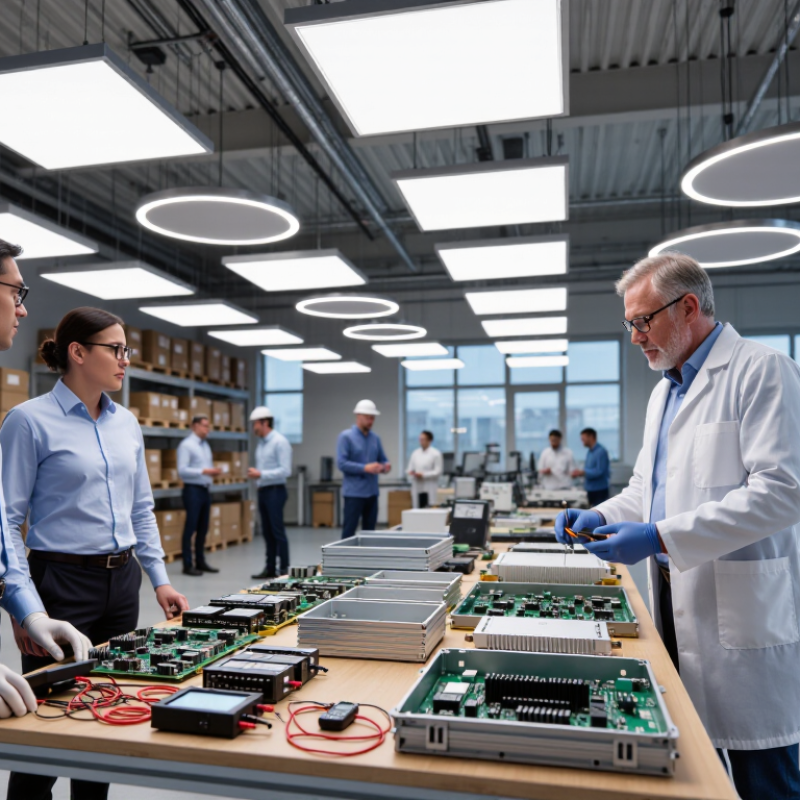
A strong working relationship needs measurable controls. Approve a golden sample and use it during bulk production inspections. Set tolerances for brightness, color variation, and cosmetic defects. Discuss spare parts, firmware support, warranty handling, and response times before payment. One overlooked connector can delay an entire shipment. We have seen polished samples hide inconsistent batch quality, so independent inspection remains worthwhile. No factory is perfect. The better partner accepts questions, documents problems, and improves the process after each order.

dLED: retail LED lighting
Privacy Overview

This website uses cookies so that we can provide you with the best user experience possible. Cookie information is stored in your browser and performs functions such as recognising you when you return to our website and helping our team to understand which sections of the website you find most interesting and useful.